
Assessing the structural integrity of active water treatment plants presents significant logistical hurdles. Traditional inspection methods require draining tanks, erecting internal scaffolding and authorising hazardous confined space entry – all of which force costly operational shutdowns. To bypass these risks, we deployed advanced UAV (Unmanned Aerial Vehicle) technology to conduct a comprehensive structural diagnostic survey within a live utility facility, entirely removing the human risk factor.
The Diagnostic Investigation
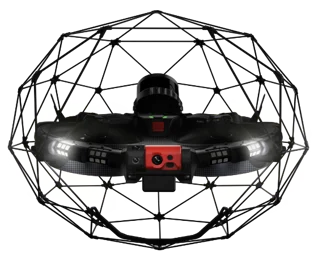
Our technical team deployed the Elios 3, an enterprise-grade drone specifically engineered for hazardous and confined environments. Skilled operators navigated the unit through the facility’s most inaccessible assets – including narrow pipework, deep tanks and intricate internal structures – where human access was either highly dangerous or physically impossible.
Rather than relying on basic visual feeds, we captured immense volumes of structural data. Utilising the drone’s onboard FlyAware™ SLAM engine and LiDAR technology, we mapped the internal environment in real time. The collision-resilient design allowed the unit to navigate complex geometries safely, while high-definition thermal imaging sensors detected minute structural anomalies, hidden leaks and moisture ingress in zero-visibility conditions.
The Outcome: High-Precision Asset Data
The survey delivered immediate, quantifiable value to the utility company. We provided a highly accurate 3D digital twin of the confined spaces, pinpointing structural defects and surface corrosion with centimetre-level accuracy.
Crucially, this critical intelligence was gathered entirely non-intrusively. By eliminating the need for confined space entry teams and physical scaffolding, the client maintained continuous, uninterrupted plant operations. Asset managers received the exact diagnostic clarity required to prioritise targeted remedial works, demonstrating a vastly safer and more efficient approach to utility infrastructure management.